

Girl Math
Sometimes 2 + 2 = survival

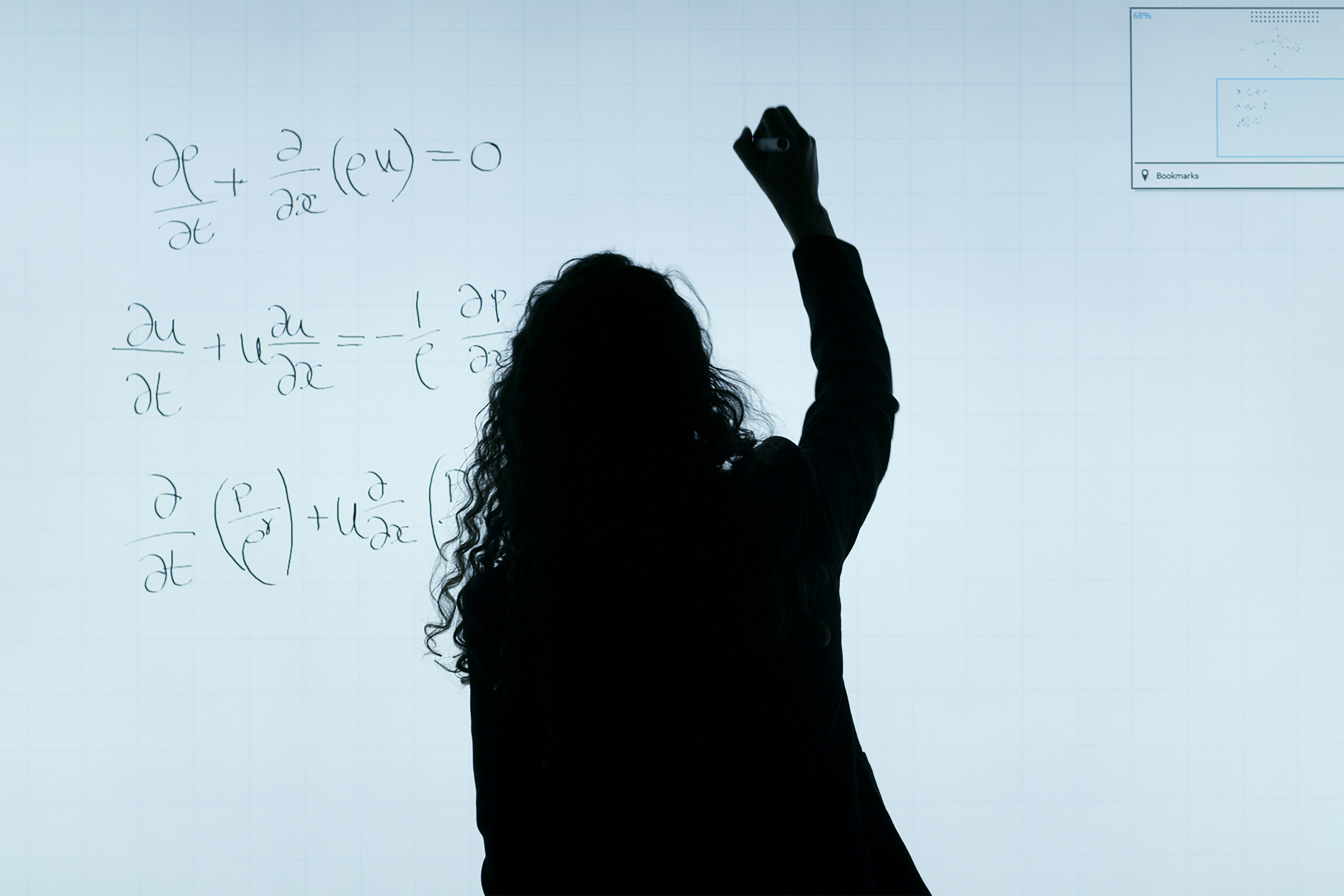
This post was sparked by a comment on last week’s essay, Women Talking.
In fifth grade, I was good at math. Good enough to get bumped up a year into sixth-grade pre-algebra. While my classmates were sweating over common denominators, I loaded my plastic tote tray and walked down the hall and into Xs and Ys. In a group of four, I was the lone girl.
Math, at least back then, made sense to me. I was a rule follower, and in math, there are rules and formulas to follow. If I plugged in the right numbers, the answer revealed itself, a mathematical rabbit pulled out of a hat.
If a girl leaves Mrs. Mohan’s class at 11:00 am and walks 3 mph to a room that is 200 yards away, what time will she get there?1
In fifth grade, girl math was just…math.
In junior high, I was flat-chested and boy-hipped, but the girls in my orbit were curving and arcing, softening into adolescence. Girl math shifted from axis points plotted on a graph to the geometry of puberty; not measuring rhombuses and triangles, but the shape of our bodies.
Theorem: All girls are similar
Proof: Translate the curve of a breast, map the arc of a hip, measure the pendulum swing of hips when walking down the hallway between class
Conclusion: Girls exist within the male gaze.
Girl math was calculating the equation of attention, both wanted and unwanted. It was pattern recognition and sequences.
If a teenage girl wears a skirt that is two inches above the knee and walks home along a busy road, how many adult men are going to honk, leer, or make a comment about the way she looks? Calculate the optimum distance from the kneecap to hemline to avoid the worst of the pervs.
When a group of football players corners you in the geography room, use the energy/mass equation to solve for harm. How much kinetic energy does a woman’s body hold? How much force is in a kick? Calculate the approximate mass of your potential attackers to conclude whether it’s better to run, scream, or laugh it off in an attempt to de-escalate.
By high school, most girls are already studying for a life exam that no textbook ever prepares us for.
In New York City, I carried a change of clothes to ride the subway late at night. Big baggy overalls and sturdy high top sneakers, an oversized mechanic’s jacket that once belonged to my father.
How many men are on a subway car as it pulls into the station? What’s the ratio of men to women? Use Pythagorean theory to find the distance between two exits.
Estimate the number of working street lamps and the radius of light they emit, and divide by the number of blocks between the station and home.
When driving alone, use Speed = Distance ÷ Time to determine how fast you need to travel to return home safely, where T is the number of minutes that it takes to run through a dark parking lot, check the backseat, lock the doors, and start the engine, and D is the number of miles until the nearest police station or public area.
Girl math becomes the calculus of being a woman.
The math of women is statistics and probability, estimates, and rounding. It is theoretical until it is applied.
In 1974, the performance artist Marina Abramović stood in front of a table with 72 objects that represented pleasure and pain. There were feathers, roses, perfume, and lipstick. There were chains, razor blades, a bullet, and a gun. The gallery audience was told they could use any of the items in any way they wanted, with no repercussions. Marina stood as a canvas, accepting all responsibility.
For six hours, Abramović stood still as her body was used, and later abused. Some audience members kissed her, and some used a feather to tickle her skin. As the evening progressed and Marina did not react, the audience grew more aggressive. They cut her clothes off with a razor, slashed at her skin, and licked her blood. Her nude body was draped in chains. She was carried and put on the table, a knife stuck into the wood between her open legs. Someone put the bullet in the gun, held it to her head, and forced her finger onto the trigger. Someone else stepped in to stop them.
The calculus of womanhood is the constant thrum of background calculations that help women navigate a world where you rarely know which men will caress you with rose petals, which will point a loaded gun to your head, and which might intervene to stop it.
Everyday math.
How much is 35% off the too-expensive boots I want to buy? What’s the equivalent of a half cup of butter in grams? If my appointment is two kilometers away, how long will it take to walk if my average speed is 3 kph?
What’s the probability of a random encounter ending in harm? What are the odds a woman’s drink will be spiked in a club? What’s the likelihood of a Tinder hookup going south, an Uber driver harassing a rider, an angry man lashing out after a rejection?
If, at some point in their lives, one in five women are raped, one in three experience domestic violence, and over half experience sexual violence, how do you calculate the odds, and how many apples does Juanita have left?
No one teaches girls and women that sometimes the best way to mitigate harm is to lie there and stay silent.
Your first-grade teacher lied. 2 plus 2 doesn’t always equal 4. Sometimes it equals grapefruit.
Sometimes, grapefruit is simply surviving.
My wowzer fifth-grade math skills eventually plateaued. I work in words, not numbers, sentences, not data. As I’ve gotten older and increasingly less visible, the unteachable math I learned as a girl shifted once again, from the calculations that kept me safe to understanding the math that makes the system works.
Why aren’t women in charge of everything? Use the order of calculations to find the answer.
Parenthesis is the qualifier of (Woman) next to your name and achievements. Exponentials is working three times as hard to qualify for the same recognition.
Multiply by the number of ways women are blamed for their own oppression, then Divide by convincing enough women to side against their own.
Add the extra time, money, and energy women use to be safe and achieve equity, then
Subtract rights that are under threat at any given time.
Maybe Marina Abramović looked at her audience and did the math of probability, maybe she calculated the number who might harm her and how far they would go, given the chance.
In a later interview, she claimed that after she had left the gallery in tears, walking past an audience who refused to meet her gaze or acknowledge what had taken place, a lock of her hair turned white.
Womanhood is recognizing that most of us are standing in front of that table. Me. You. Mrs. Mohan. All of us doing the invisible girl math of trying to figure out who is going to harm us given the chance, and calculating the best way to leave the room alive.
If a woman writes a thousand words a week for 60 weeks, will it make a difference? Thank you for being here and for your continued support. If you like what you read, please consider subscribing, dropping a tip in the jar, or just letting me know. xxx dmh
11:16 am
It's too bad that so many women do their girl math and come up with an answer that they believe to be the correct one, rather than realizing that it's the fact that a calculation had to be made at all that is the problem. I used to think that the solution was to get boys to do girl math as well, so that they could understand the problem. But like girls who come up with what they think is the right answer, many boys are unwilling to see that the math shouldn't have to be done in the first place.
"The calculus of womanhood is the constant thrum of background calculations that help women navigate a world where you rarely know which men will caress you with rose petals, which will point a loaded gun to your head, and which might intervene to stop it."
THIS! This says it ALL.