

Writing While Female
"You write like a girl," he said

I needed to get this out of my head before I could work on Friday’s essay. I hope I can get that one done too. x d
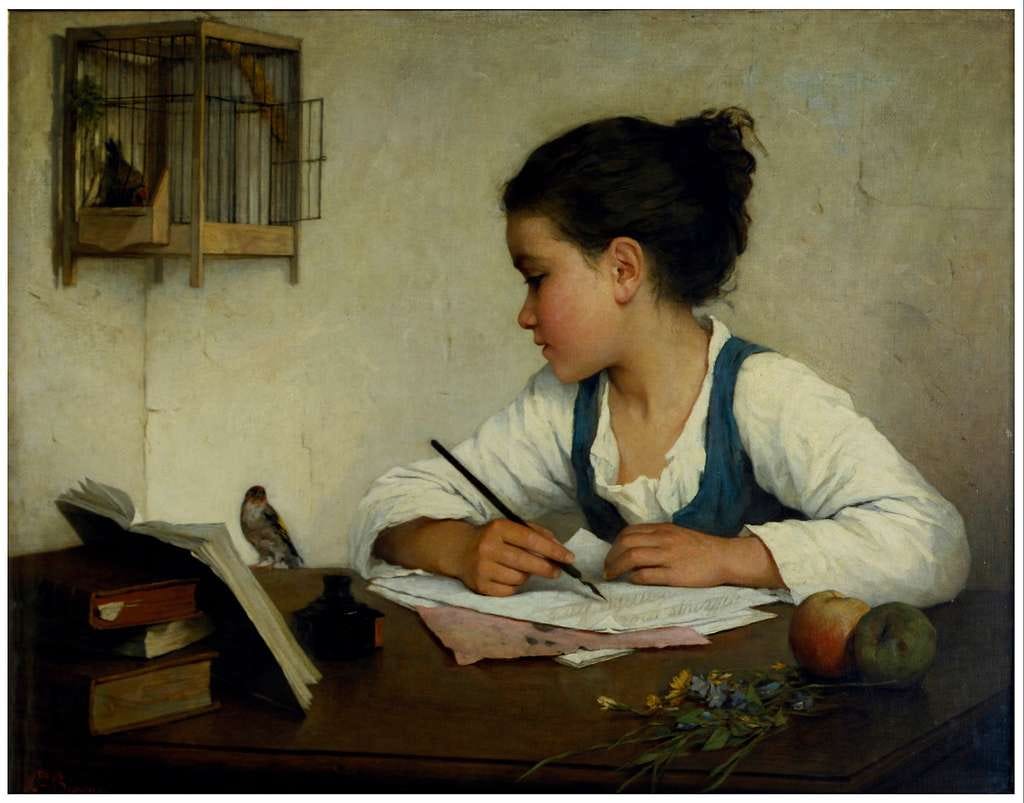
In college, I sat with my peers in classrooms and living rooms while we critiqued each other’s words. Workshops were always guided, led by someone who was there to make sure we didn’t kill each other.
Metaphorically.
Mostly. Writers, especially young writers, can be competitive and ungenerous.
The rules, though, were always the same. Start and end with the positive, sandwich the rest in between.
Do they still teach workshops like this nowadays? I honestly don’t know. I’m old. I studied in the last century, and maybe things are different now. Maybe it’s a writer-eat-writer world, and may the best scribe win. Like Squid Games.
There’s a joke about ink in there somewhere.
The first bio I ever wrote, for my college literary journal, read in part:
“Dina Honour has been told she writes like a girl.”
It was a petty-ish rebuttal to a classmate who, upon lamenting he couldn’t relate to my work, told me that I wrote like a girl. He did not mean it as a compliment.
I wish I could tell you that it didn’t bother me, but it did. It stuck in the back of my mind like a stubborn seed. I tried, briefly, to erase whatever femininity he seemingly picked up on like a menstrual bloodhound, but when I did, my writing fell flat. It was neutered, all the pink sucked out until I was left with ghostly shapes on the page, as if the ink was running out.
I don’t think my classmate was being intentionally hurtful. Or maybe he was, who knows? Young writers can be ungenerous.
I think it’s more likely that he was used to reading stories that he could see himself in, stories and words that matched up with his male eye view. When he read mine, he couldn’t see himself there.
You write like a girl was both chastising and expectant. I wasn’t writing for him. If I wanted him to relate to my work, I should make it easier for him to understand. I should write things that he didn’t need to work so hard to see.
When you’re writing while female, some people like you to follow a set of unwritten rules.
In this space, I primarily write about women. If I write like a woman, it’s not because my shriveled fallopian tubes are doing the typing, but because everything I see and do and study and touch is pushed through a sieve of womanhood.
It’s been decades since I sat in a classroom, but it seems like there’s still a set of unwritten rules you’re meant to follow when writing while female. Especially, I’ve been informed, if you want your work to appeal to women and men.
Some people get very upset if you don’t abide by those rules.
The Rules
If a woman opens a trauma vein and bleeds across the page, somewhere within the words of her own pain, she must note that men suffer harm too.
If a woman writes about the way that she has been terrorized, she must be careful to criticize the structure, never the individuals who make up the vast majority of the structure.
If a woman writes about girls who are denied education, or forced into marriage as soon as they start to bleed, she must also include the ways that boys are falling behind in school.
If a woman writes about how one in four women will be sexually assaulted in their lifetimes, she must reiterate that not all men are rapists, and that men are assaulted as well.
If a woman writes about a bear, she must mention, in passing at least, the dangers faced by men in war and peace.
If a woman writes about the historical lack of funding for women’s health, she must not forget to mention male suicide success rates.
If a woman writes anything at all, she should model grace and empathy. Very demure. Very mindful, with no expectation to have that grace returned in kind.
If a woman writes about the global epidemic of violence against girls and women, she must acknowledge violence against men, despite the asymmetry and commonality of those perpetrating the violence.
If a woman writes the word men she must balance it with “and some women.”
If a woman writes about the challenges faced by women, she must be sure to sympathize with the challenges faced by men.
If a woman is writing anything at all, she must, and this is important, remain calm with her hands inside the vehicle at all times. Anything else is just emotion.
If you smiled more when you wrote, you’d be a lot more attractive to your readers.
In this space, I write primarily about women. That truth does not negate the fact that terrible, horrible, no good, very bad things befall boys and men every day. Nor does writing primarily about women mean that boys and men do not face challenges.
Do I then have a duty to shape my work to make it easier for good men to find themselves within? How is that any different from that male classmate who told me I wrote like a girl?
If women’s experiences don’t matter unless they are compared and contrasted against the experiences of boys and men—well, that statement sort of speaks for itself.
For many women—not all—writing while female is not much different than living while female. There’s a set of rules that you’ll never completely understand because they change as you go, like dynamic pricing. A woman Uber. You can try to change yourself to meet those expectations. You can play nice and follow the rules for a while.
But in my experience, you’ll usually end up neutering yourself in the process, sucking out all the color until you end up like ghost words on a page.
There are always going to be people who get mad because you’re not behaving in the way they think you should. For the most part, let them.
It took me too long to realize that I never should have seen write like a girl as an insult, even if it was meant that way.
It was always just the truth.
Thank you for being here. Thank you for what you do. There’s such a phenomenal community of writers here, and for that I am thankful every day. If you find yourself nodding along, please do the usual: like, comment, share. Subscribe, upgrade, or drop a tip in the jar. All proceeds go toward continuing to write like a woman. xxx dmh
Ah, Dina. You said a mouthful. I once read a study that said if a teacher calls on girls more than 30% of the time, boys think the girls are being called on more than the boys. It speaks volumes, doesn't it? I once had a boss tell me I think like a man. I told him that's not the compliment he thinks it is. He had the good graces to look mortified and apologize.
I would be happy to follow the rules if men returned the favor. It’s always been the double standard that’s the problem. Women are always seeing themselves through the eyes of men. We have to, for our safety and survival. If we are capable of doing so, then so are men. The old saying “what’s good for the goose is good for the gander” should be “what’s good for the gander is good for the goose.” Equal treatment, equal access, equal empathy, equal rules. That’s all we’re asking for. That’s all we’ve ever asked for. It’s actually quite simple.