

The Hero's Journey
Show me the women

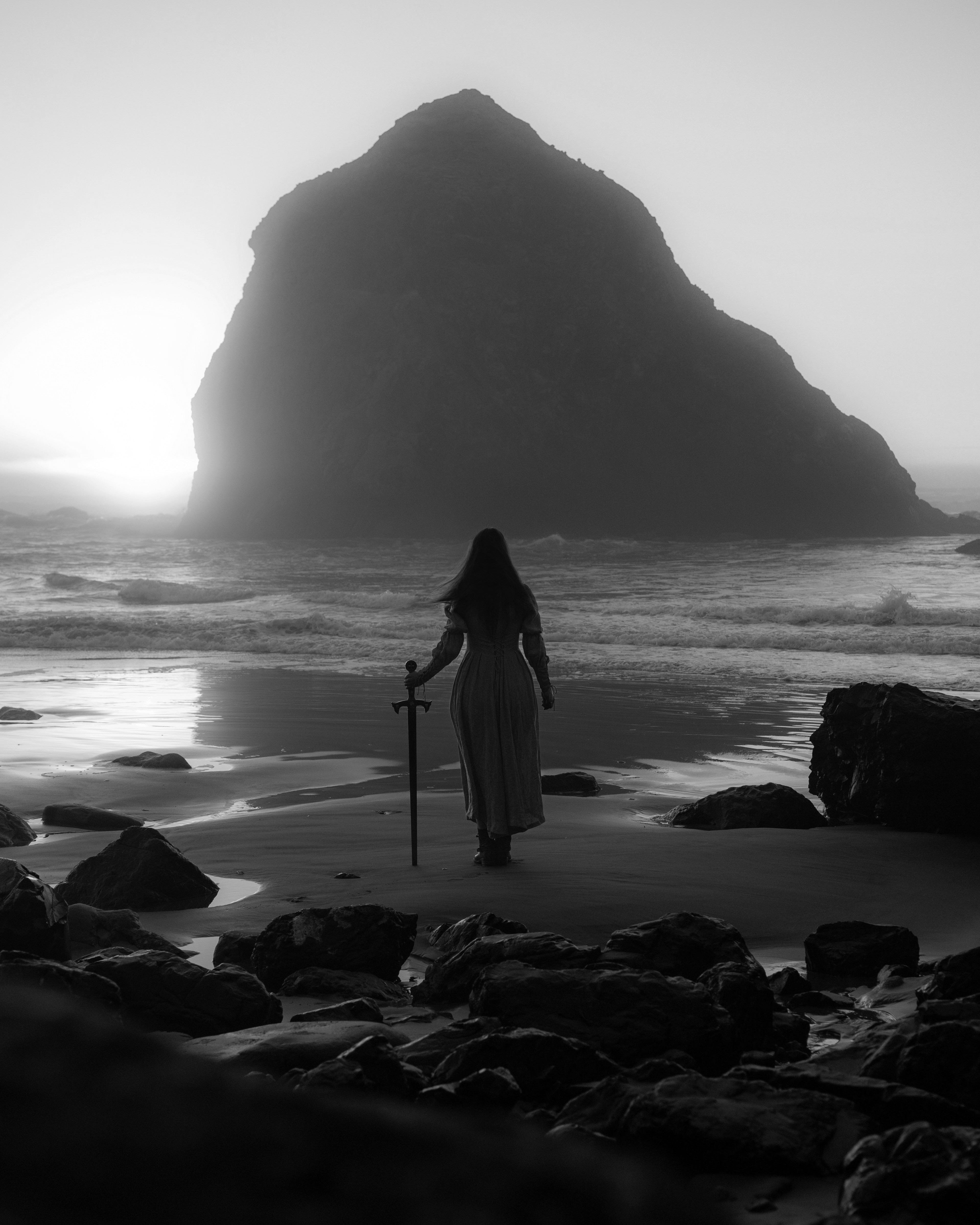
The great epics, the stories with marquee names, the texts that pepper college syllabi like heroic confetti, are almost universally about men. Gilgamesh, Odysseus, Hercules. Frodo, Luke, Paul Atreides. The bold journeys to faraway lands, the internal struggles into hearts of darkness, they’re the stories we can pluck from our collective canon. They are the stuff of rhythmic staff banging, of bards and bow song.
There may as well be a sign at the beginning of the hero’s journey that reads no girls allowed. The terrain is uneven, the water’s too deep, and look, someone’s got to stay home and look after the kids. Anyway, you might break a nail.
I get it. The stories are big and exciting, the accounts of battles and conquests, voyages and expeditions, of mighty kings and kingdoms. Throw in an expansive landscape, full of sky-scraping mountains and wide seas, a few identifiable villains, and voilà. Congratulations, it’s an epic!
Long sea voyage and a giant monster whirlpool? Thrilling. A lone witch, stuck on a craggy rock of an island by herself? Who wants to read about affairs of the hearth? Snooze fest.
Women didn’t stand a chance.
Historically, we were rarely allowed the autonomy to climb every mountain or the independent fortune to ford every stream. Hell, even our clothing worked against us at times; waterlogged petticoats will pull you under the waves faster than you can say fifteen men on a dead man’s chest, and whalebone stays make adventuring difficult on the best of days. And anyway, we might break a nail.
So it went. Men did the adventurous stuff and women…well, women couldn’t. Different men wrote about it and women…were off getting their hair done, I guess. It’s easy to look at the picture we’ve been given and assume that women were content enough to leave the hero journeying to the fellas, happy enough to stay home and tend the pigs.
“Odysseus, you know how much I love watching you work, but I’ve got Ithaca’s 500th anniversary to plan, a feast to arrange, my cousin to chastise, and Troy to frame for it. I’m swamped. Go, get out of my hair.”
And maybe women were content, who am I to say? I’m just a 21st-century woman who’s standing in front of the world, asking it to be just a tiny bit more imaginative.
It can’t be that hard to imagine a version of Helen who, bored with her Spartan trinkets and grossed out by Menelaus scratching his balls with the same hand he eats with, manifests a different future for herself. Maybe she had a mood board or a bullet journal. Is it so hard to imagine that when a shiny boy toy entered the group chat, she saw her chance? Maybe she stood on the bow of that ship like Rose from Titanic and felt the wind in her hair, free for the first time in her life.
Is it difficult to imagine Penelope, fed up with the boorishness of her suitors, the blandness of her mutton, and the constant whinging of her son, longing to chuck it all in for something simpler? #Boatlife.
In heroic tales, female characters are often passive. Muses and stepping stones, soft ports to dock in. They don’t even get the courtesy of a rich inner life.
Am I to believe that none of these women had a deep longing for something more, a desire for adventure, a pull toward a heroic journey of their own?
No one else finds that weird?
For most of history, women were confined and constricted by laws, misogynistic misconceptions, and religious men in ridiculous hats. That is to say, it’s not surprising that large numbers of women weren’t taking to the high seas to see what they could see, see, see.
It’s a mistake, though, to conflate women’s absence from seafaring and city-sacking with the idea that women lack stories just as rich.
Story arcs don’t give a flying fallopian tube what sex you are. Quests are not gendered. The beating heart of any hero’s journey—survival, bravery, and change—does not belong to men alone.
Women have stories of heroism and survival, of struggle, brilliance, and resilience, too. They’re just largely missing from our collective psyche.
Would it kill someone to make a movie reimagining the last days of Troy through the eyes of Hecuba, or a film about Clytemnestra’s righteous rage?
Give me an unrepentant Helen who picks up arms against her own husband once she figures out that she is the real Trojan Horse, a gift welcomed into Troy as an excuse for her dickhead brother-in-law to sack the city. Or a fed-up gang of Trojan women burning ships. Given me the restraint and resilience of Andromache in her old age, outliving all of them.
Show me the women.
Show me the women. Show me their rich inner and outer lives, the suffocated dreams and the sacrifice, the yearning, the rage. Show me the frustration at confinement, of inaction, of being kept behind screens and in castle keeps.
They are right there, just waiting for someone to come along and tell their stories.
Mythology has gifted us an exiled sorceress whose story is a perfect metaphor for consent. Island as body, the embodiment of female rage. Is there a woman alive who hasn’t wished she could turn some men into pigs?
Give me Circe, snacking on bacon bits and wiping her chin.
It’s lazy to assume that women didn’t yearn for the story arcs men have always been allowed. It’s arrogant to fail to recognize that women have lived journeys in the confined spaces you’ve allowed us—in the vaster wilds of motherhood, in the world between the harem walls, in sacrifice, love or grief.
Not all heroic journeys need a sea voyage, and sometimes the monsters you encounter aren’t in caves, but sleeping next to you in bed.
Are stories of survival and resilience, of internal pilgrimages and overcoming odds worth less because they’re smaller in scale, or because they’re confined to homes and hearths rather than oceans and icy mountaintops?
Was Scheherazade any less cunning than Odysseus because she was bookended by marriage rather than adrift upon the ocean blue?
Men sang the stories of men, and later, men wrote those stories down. And so those are the stories that resonate, the ones that are retold and reimagined time and time again.
No one bothered to write down women’s stories. And so we’re left with half a historical record, one that assumes those stories weren’t worth remembering.
Don’t be fooled. Women too are bards, passing down our own stories of resilience and survival, of legacy and tradition.
Our bows might be tuned to a different frequency, but that doesn’t make them any less resonant.
Tell me your stories, and I’ll tell you mine. You know the routine. If you like what you’re reading, please like, share, comment. And, if you’re looking for another way to support Feminist writing like mine, there are still a few days to lock in an annual subscription of American Woman at a 50% forever discount (17 USD) xxx dmh
Love your gimlet eye. And please, whoever is going to write these stories, don’t just turn the man question into a man quest with a vagina and skirts. Women don’t think or act like men do and we are not like them. We deserve our own stories.
@Dina Honour have you read Madeline Miller’s book Circe? One of my absolute favorites bc it does exactly what you are asking for, gives her a rich inner life, ambitions, and an amazing arc. (Not to mention beautifully written). I have been pining for a movie version of this Circe since the first time I read it. Now after multiple reads and all the Odyssey buzz, I am demanding it!